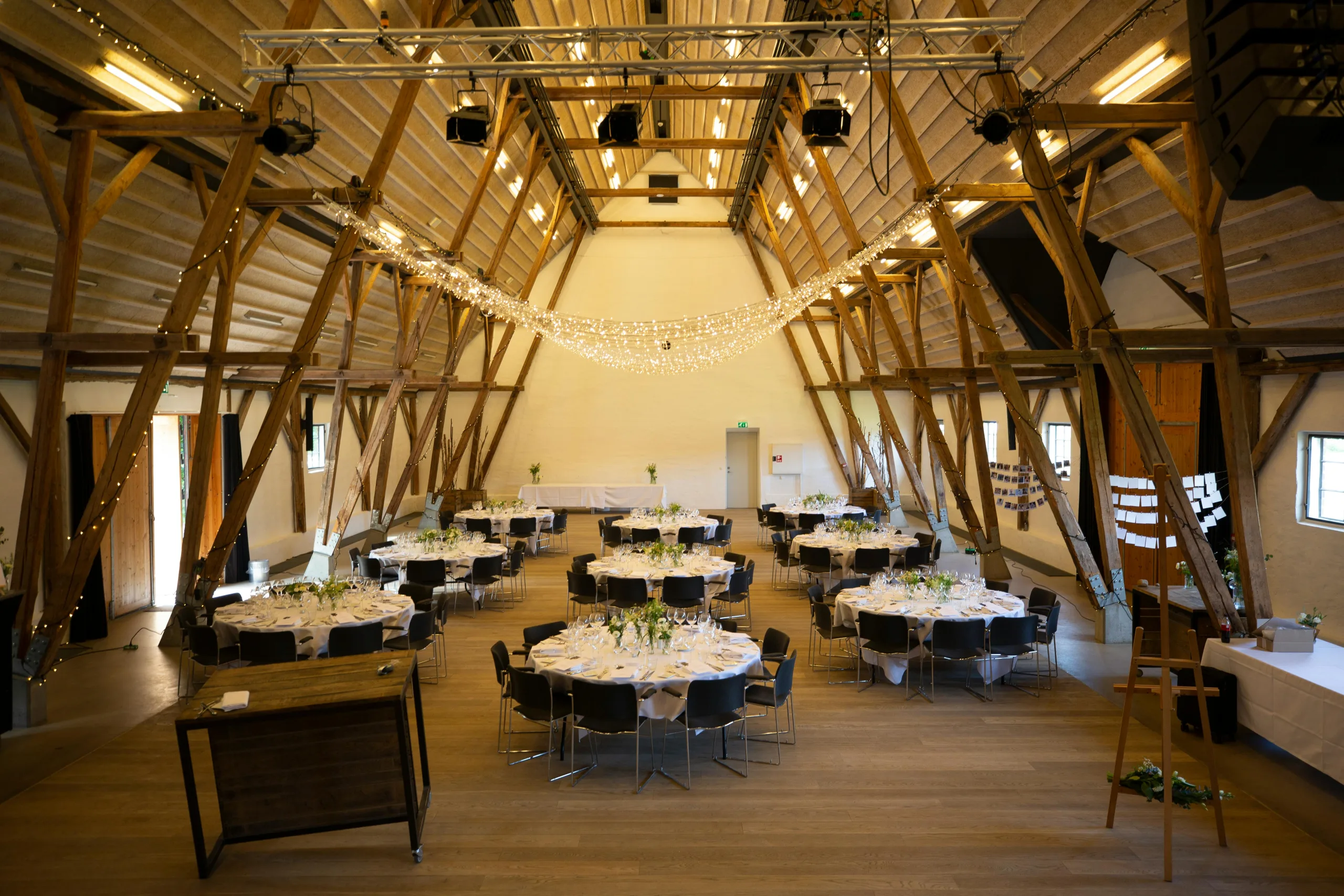
The majority of the trend reports get this wrong. They take it easy by only listing what things look like. They don’t explain why they are popular or why they work so well. What’s worse is that those lists don’t tell you the reality behind attempting to do any of the trends. Here’s what you need to know going into 2026 about the event design trends that are taking over.
1. Layouts Replace Programming
Packed agendas used to signal value.
Now they signal fatigue.
Rooms are being designed to carry the experience without relying on constant direction. Guests move more freely, and moments are discovered rather than announced.
When layouts are intentional, you don’t need to force participation. You control flow instead of managing it.
When they’re not, you compensate with more programming.
And guests feel that immediately.
2. “Soft Arrival” Over Grand Openings
The dramatic entrance is losing relevance.
Not because it doesn’t look good.
Because it disrupts how people actually arrive.
In 2026, arrivals are being absorbed, not staged.
Guests enter into environments that are already active. There is no hard start and no moment where everyone is expected to shift attention at once.
This reduces friction immediately.
You are not asking people to perform attention. You are giving them space to settle into it.
3. Multi-Zone Environments Instead of Single-Purpose Rooms
One room with one function and one energy level is no longer holding attention.
Spaces are now layered in a way that allows for variation. There are areas that carry energy, areas that allow for quieter conversation, and spaces that act as transitions between the two.
This shift is not visual. It is behavioral.
People do not maintain one level of engagement for hours. If you design for a single energy level, you lose them. If you design for variation, they stay longer without realizing why.
4. Lighting Does the Heavy Lifting
Decor used to be the star of the show. That’s not the case anymore. These days, physical decor is becoming secondary and lighting is becoming a focal element. Lighting highlights the structural elements of the venue. It directs guest attention. It sets the entire mood of the event.
Lighting at an event does the heavy lifting, helping a room feel energetic and alive.
5. Passive Engagement Outperforms Interactive Installations
Interactive installations are cool and all, but nobody appreciates forced participation. This is one of those trends that went too far in one direction and is now swinging back the other way. Engagement is great, but it needs to be natural. Top NYC event planners are designing participation so it feels optional.
Guests should interact with your installation because they want to, not because they feel obligated. The environment should invite them in, enticing rather than demanding.
6. Transitional Moments Are Being Designed Intentionally
Most events still treat transitions as dead space.
That is where they lose control.
The shift from arrival to main room, from main room to breakout, from dinner to after-party—these are not gaps. They are pressure points.
In 2026, planners are designing transitions with the same precision as main moments.
Because this is where energy drops, confusion builds, and timelines begin to slip.
If transitions are smooth, the entire event feels elevated.
If they are not, nothing else recovers it.
7. Furniture Provides Direction, Not Decoration
Furniture is no longer about filling space.
It is about controlling movement.
Placement determines where people stop, where they gather, and how long they stay. Straight lines create flow. Clusters create pause.
If your furniture layout is neutral, your room has no guidance.
And when there is no guidance, guests default to the perimeter.
8. Audio Centralizes the Experience
One stage. One speaker. One direction.
That model is fading.
Audio is being distributed to match how people actually move through a space. Different areas carry different levels and purposes, allowing conversation and programming to exist at the same time.
When audio is centralized, everything competes.
When it is spatial, everything coexists.
9. Branding Is Being Integrated
Placing logos everywhere is the literal approach to branding. It feels loud and in-your-face. While that may work for some brands, it isn’t the right choice for all brands. High-level event planners know how to do branding without being literal.
Branding in 2026 takes a more elegant approach. It’s the material choice, textures, color transitions, and design decisions. The goal is to make guests feel the brand rather than stare at the logo over and over.
10. Timelines Focus on Energy
A timeline can look good on paper, but fall apart when put into practice. It fails in the room. The time isn’t the issue. It’s the energy. High-level event planners think about the clock and the vibe.
They understand that humans have limited attention spans. With that, their energy peaks and valleys. After a peak and drop of energy and attention, guests need a release. It’s a mental break to reset and be ready to re-engage for the next segment.
When these moments aren’t correctly placed in the timeline, it creates a disconnect. Guests struggle to pay attention and engage.
11. What Most Planners Will Do Wrong
The biggest mistake novice event planners make is trying to replicate trends in event planning. They are so focused on the look that they miss the trend’s function and purpose. It’s pointless to add zones without understanding flow. An event becomes weaker when you reduce programming without adding structure to the layout. A simplified design falls flat when you don’t supplement it with other elements.
Without this intuitive approach, the event feels incomplete rather than intentional.
What High-Level Planners Are Actually Doing
Industry leaders don’t chase trends, then make them. How do you make a trend, though? They look for places to improve. Identify the purpose or need behind a trend. There is usually something that the trend is solving. Top NYC event planners find these pulse points and then build a system around them. The trend is just the physical manifestation of problem-solving.
Learn More About Event Design Trends at The Event Planner Expo
While you can implement these trends quickly, speed isn’t always an advantage. It’s more important for you to understand execution. Trends start out as unique and innovative, but they quickly become the standard.
Be in the room at The Event Planner Expo 2026 with NYC planners and producers who are not following trends. Learn how top event planners are successfully executing these trends. Get tickets to The Event Planner Expo 2026.