The majority of event planners can design an event that looks good. That isn’t the problem. The problem is that a beautiful event doesn’t carry forward with a strong brand identity or lasting company impression. People remember the vent and not the business behind it. In 2026, that disconnect is a big issue for clients. It’s what separates a party from a brand experience.
1. Start With Behavior, Not Visuals
Most branded events still begin with aesthetics. Event planners jump right into color palettes, florals, signage, and materials. They assume those choices define the experience. That’s where the problems usually start. A brand is more than visuals. It has substance. An event needs to convey that substance to the guests.
2. Remove Everything That Doesn’t Belong
The traditional method for planning an event is to add the branding to an event you’re already planning. But in reality, that isn’t the best approach. Instead, you need to think about what you need to remove.
Trying to add the branding afterward is like slapping logos on an already designed event. It makes the branding feel like an afterthought and disconnected. When you focus on the things you can get rid of, you eliminate the extras.
3. Let the Layout Reflect Brand Structure
Many NYC event planners don’t consider layout when they are thinking about event branding. They should be. Layout is just as much a part of branding as every other element of the event. The layout directly impacts how guests experience the event and interact with other guests. All of that behavior directly impacts guest behavior, which translates to their experience.
Brands with a clear hierarchy structure should have a layout with clearly defined flow and focal points. Brands that are collaborative should have a layout that’s more inclusive and natural-feeling.
4. Control the First Impression
First impressions happen sooner and faster than most event planners ever realize. They are happening as guests walk up to the venue. They are solidifying by the time guests arrive and enter. That opinion will set the tone for the guests’ experience for the rest of the event.
When the entry doesn’t align with the brand, there is a disconnect. Now, the expectations that you’ve set are thrown out of the window as guests mentally scramble to figure out what the event is about. Everything else afterward has to work harder to realign guests.
5. Use Repetition Without Being Obvious
Repetition is a must for effective branding. However, there has to be a balance. People don’t want to be hammered away with branding over and over. That will have the opposite effect. Instead, event planners need to be creative in applying repetition. It needs to be more subtle and consistent.
The trick is to have guests experience and remember the repetition without actively noticing it. This approach holds the environment and event together. The branding doesn’t feel too forced. It feels integrated.
6. Align Lighting With Brand Tone
It’s still the standard for event lighting to be treated like an afterthought. It’s that neutral layer that is transferred from one event to the next. That approach is a mistake because it plays a much larger role than that. Lighting defines the venue’s tone faster than almost anything else in the room. Sharp and modern brands lose their edge in overly warm, diffused lighting. Intimate brands feel exposed in overly bright lighting. An energetic brand will fall flat in a space that feels static.
Lighting either reinforces the brand or quietly works against it. There is no middle ground. This is where many events fall slightly out of alignment. The design works, but the lighting does not support it, and the entire room feels just a bit off. When lighting is aligned with tone, everything else reads more clearly.
7. Design for Memory, Not Moments
It is easy to design around standout moments. A large installation or a dramatic focal point can create immediate impact. But impact does not always translate into memory.
Brand experiences rely on consistency from beginning to end. Guests should leave with a clear sense of the brand, not just a few isolated highlights. That means the experience needs to hold together across every part of the event. No sections should feel disconnected, and no moments should feel like they belong somewhere else. Memory is built through continuity, not just peaks.
8. Let Materials Carry the Brand
Don’t fall into the trap of only focusing on visuals for branding. Sure, logos and signage get all of the attention. But there’s so much more than that. Materials can also communicate information about the brand. Think about how you react to matte vs gloss. How soft vs structured impacts you. Do you feel more comfortable in a raw or refined space?
Luxury brands feel elevated with the use of high-end materials. Modern brands feel that way because of the finishes in the space. A relaxed brand is welcoming because the materials are soft and pleasant to touch.
9. Control Transitions Between Spaces
Most events lose their cohesion in the transitions. It’s like a hard, unexplained stop to one experience and no explanation or preparation before the next one. Those harsh shifts are mentally jarring for guests. It breaks their flow and can cause them to disengage.
A branded event that does things well has continuity throughout the layout and timeline. Transitions feel connected, and the space feels cohesive. Guests don’t feel like they are entering a completely different environment when they move between the zones or rooms.
10. Make the Brand Feel Inevitable
The strongest branded events feel like they have merged the brand with the event. There is no moment where the brand is introduced because it is already present in every decision.
Everything supports the same identity. Nothing feels added after the fact. Nothing contradicts the overall direction. That level of cohesion makes the event feel complete.
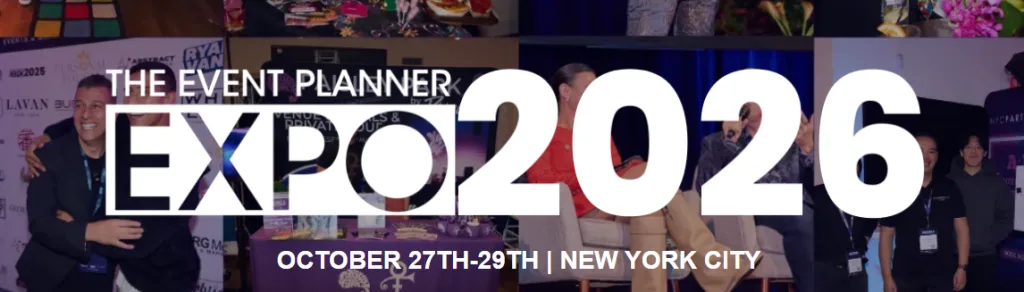
Learn More About Branding Event Design at The Event Planner Expo
Social media has educated all of us about branding. Clients are taking this business marketing principle and using it personally. Branding an event doesn’t mean putting logos everywhere. They are the ones where every decision supports that identity without needing to say it out loud.
Be in the room at The Event Planner Expo 2026 with NYC planners and producers who are not adding branding to events. They are designing events that cannot be separated from the brands they represent. Claim your space at The Event Planner Expo 2026 before availability closes.