A trade show booth has seconds to answer three questions for a passing buyer: What do you do? Is it relevant to my events? Should I stop and talk to you? The strongest trade show booth design ideas make those answers obvious. They give corporate event buyers a reason to step out of the aisle and start a useful conversation.
That matters even more when you are exhibiting at an event-industry conference. Corporate planners and marketing professionals are not simply browsing. They are evaluating partners who may help deliver future events, brand activations, conferences, and celebrations. Your booth needs to look polished, communicate a focused promise, and make the next step easy.
Use these ideas to turn your footprint into a buyer-friendly experience, whether you are preparing for an exhibitor opportunity at The Event Planner Expo or refining a display for another industry event.
What Makes a Trade Show Booth Effective?
An effective booth is not the one with the most décor, technology, or giveaways. It is the one that helps the right attendees understand your value and decide to engage. Before you pick furniture, lighting, or graphics, define the buyer journey you want to create.
- Stop: What will make the right attendee notice your booth from the aisle?
- Understand: Can the attendee grasp your offer within a few seconds?
- Engage: What will prompt a relevant conversation or demonstration?
- Continue: How will your team capture interest and make follow-up feel natural?
A booth designed around that sequence is easier to navigate and easier to remember. It also helps your sales team spend more time speaking with qualified prospects instead of explaining a cluttered display.
12 Trade Show Booth Design Ideas for Corporate Event Buyers
1. Lead With One Clear Buyer-Focused Message
Your booth should have one primary message that can be read quickly from the aisle. Instead of listing every service you provide, choose the problem you solve or the outcome you help create. A production partner might lead with seamless show execution. A venue may spotlight flexible corporate event space. An event technology provider may focus on stronger attendee engagement.
Use a short headline, a supporting visual, and only the most important proof points. Large graphics are useful when they clarify your offer, but extra copy creates friction. If an attendee needs to stand still and read a paragraph to understand your business, simplify the message.
2. Design a Welcoming, Open Entrance
A booth packed with tables, chairs, product cases, and team members can feel difficult to enter. Keep the front edge open. Place your main conversation space a step or two inside the footprint so visitors can move naturally from the aisle into the booth without feeling trapped.
Think about where attendees will pause, where your team will stand, and where people may gather during a demonstration. Even a compact booth can feel inviting when there is a clear path in and out. For larger booths, use more than one entry point so buyers approaching from different directions can engage comfortably.
3. Build Your Background Into the Story
Your background is often the first visual anchor buyers see. Treat it as more than a decorative wall. It should reinforce your brand and communicate your main value proposition from a distance.
Choose high-quality visuals with a clear focal point. Keep essential text above furniture and other obstructions. If you need help choosing materials, layouts, and visuals, review this guide to picking the right trade show background. The goal is not to fill every available inch. It is to give your booth a confident visual identity.
4. Show Buyers the Experience, Not Just the Service
Event buyers respond to experiences because their work is experiential by nature. If you sell catering, offer a tasting moment. If you provide entertainment, create a brief, high-impact preview. If you offer event technology, let buyers test a feature. If you design décor, build a small vignette that shows how a space can feel.
The key is restraint. One memorable interaction is more effective than several disconnected attractions. Choose an experience that makes your service easier to understand and gives your team an opening for a relevant conversation. For more inspiration, explore these experiential marketing ideas for B2B events.
5. Use Lighting to Guide Attention
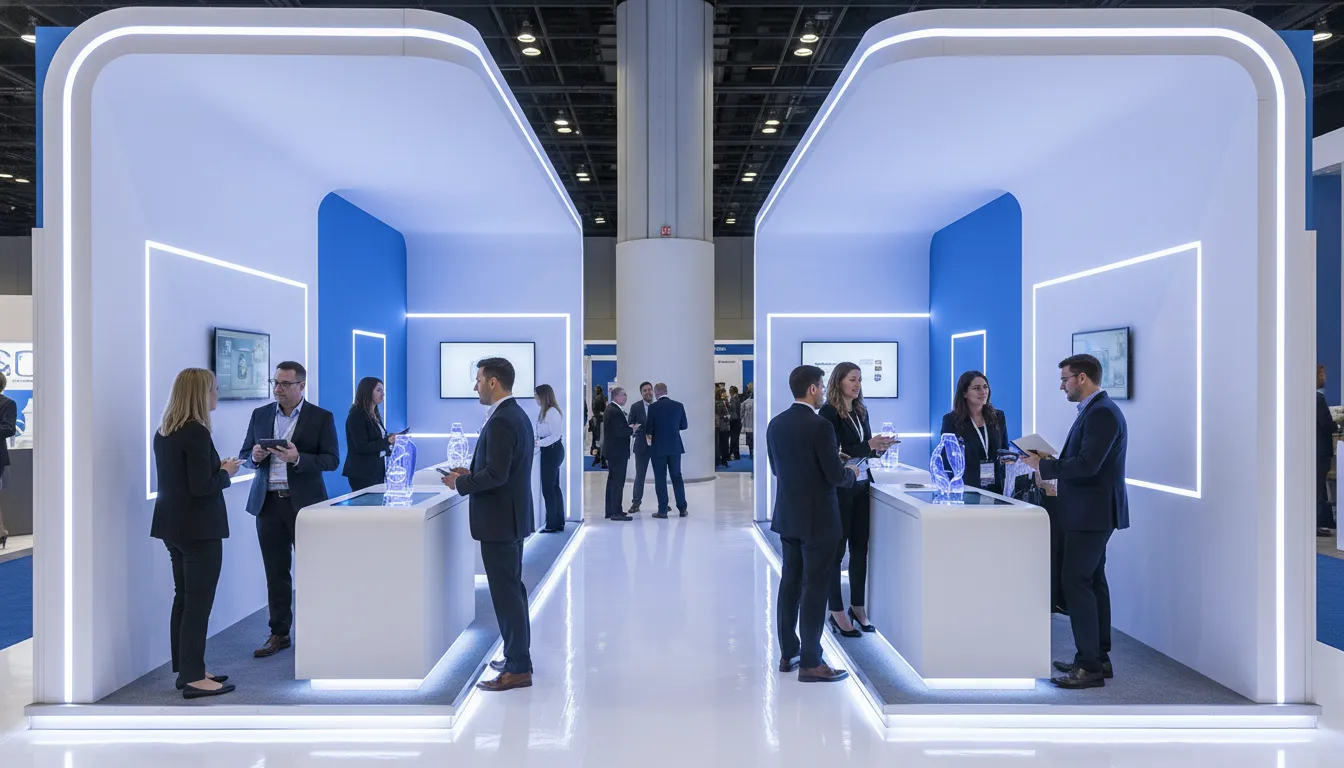
Lighting can make a small booth feel premium and help visitors notice what matters most. Use it to highlight your logo, a featured product, an event vignette, or a demonstration area. Backlit graphics can create a clean visual presence, while accent lighting can add depth to décor and display elements.
Avoid lighting that makes conversation uncomfortable. Harsh glare, dim corners, or flashing effects can work against an otherwise polished display. Your lighting should support the buyer journey: attract attention, clarify the focal point, and keep the booth welcoming.
6. Create a Quick Portfolio Moment
Corporate event buyers need to picture your work in action. Give them a fast, curated way to see it. A screen with a short reel, a digital gallery, a lookbook. Or a small set of before-and-after examples can help buyers understand the range and quality of your work without turning the booth into a presentation room.
Keep the portfolio focused on the clients and events you want to win next. If you serve different segments, group examples so buyers can find the most relevant work quickly. Add context where useful: event type, challenge, and the result your team helped create. Avoid an endless slideshow with no clear point of view.
7. Plan a Demonstration With a Defined Takeaway
A demonstration is strongest when visitors can understand its purpose within a minute or two. Decide what you want buyers to learn. Then make that takeaway obvious before the demonstration begins.
For example, an event-tech company might demonstrate a check-in workflow, an engagement tool, or a reporting feature. A rentals company could show how a modular element transforms a setting. A production team might use a compact visual to explain a capability. If technology is part of your display, these event tech tips for trade show exhibitors can help you plan a more useful experience.
8. Add a Conversation Zone Without Closing Off the Booth
Some prospects want a quick introduction. Others are ready to discuss an upcoming brief. Design for both. Keep the aisle-facing area open for initial engagement and create a secondary conversation zone for deeper discussions.
In a smaller booth, that may be two stools and a narrow counter placed toward the back or side. In a larger footprint, it may be a lounge area or semi-private meeting space. Do not let seating dominate the entrance. You want buyers to feel welcome to step in, not worried that they are interrupting a meeting.
9. Use a Tactile Detail Buyers Will Remember
A tactile detail can make your booth more memorable when it connects to your service. Think fabric swatches for a décor partner, material samples for a rentals team, menu cards for a caterer, or an interactive planning board for a creative agency. The item should invite a question or help a buyer make a decision.
This approach works because it gives attendees something specific to discuss with your team. It is also more distinctive than a generic giveaway pile. Choose an element that reinforces your positioning and is easy to reset throughout the show.
10. Make Lead Capture Feel Like the Next Logical Step
Your booth design should create a clear transition from conversation to follow-up. Place lead capture tools where your team can use them naturally without blocking the entrance. A concise QR code callout, a tablet form, a meeting-booking link, or a well-organized scan process can work.
Give buyers a relevant reason to continue the conversation. Offer a portfolio, planning guide, consultation, demo, or follow-up resource aligned with their interests. Make the ask specific. “Book a demo” or “Get the corporate events lookbook” is more useful than a vague invitation to learn more.
11. Extend the Booth With a Sponsorship Touchpoint
If you want to build visibility beyond your booth footprint, consider how sponsorship placements can reinforce your presence. A strategic touchpoint before, during, or around the event can create familiarity before a prospect reaches the expo floor. When that buyer later encounters your booth, the conversation starts with stronger recognition.
The best combination is consistent: the sponsorship touchpoint introduces the same focused message that your booth brings to life. If broader brand exposure is one of your goals, explore sponsorship opportunities at The Event Planner Expo.
12. Give Buyers a Reason to Talk About You After the Show
Memorable booths usually have one repeatable idea. It may be a beautiful visual moment, a helpful mini-consultation, a smart demonstration, a strong takeaway, or a creative activation. Pick one signature element and design the rest of the booth to support it.
Ask yourself: If an attendee describes our booth to a colleague later, what do we want them to say? If the answer is unclear, keep refining. A strong booth is easy to explain because its message and experience work together.
Trade Show Booth Design Mistakes to Avoid
Even ambitious displays can miss the mark if the booth becomes harder to understand or navigate. Watch for these common problems:
- Trying to communicate everything: Too many messages make the booth difficult to process. Select one primary promise and a few supporting points.
- Blocking the entrance: Large counters and clusters of staff can discourage visitors from entering. Keep an open path from the aisle.
- Using technology without a purpose: Screens, QR codes, and interactive elements should support a buyer action or insight.
- Choosing giveaways unrelated to your brand: Prioritize relevance and conversation value over volume.
- Forgetting your follow-up process: The booth is the start of the relationship. Plan how you will record interest, segment leads, and reconnect.
- Designing only for photographs: Visual appeal matters, but your layout must also work when the aisle is busy and multiple buyers want to engage.
A Pre-Show Booth Design Checklist
Before your team arrives on the show floor, review the booth from the perspective of a buyer who has never heard of your company.
- Can attendees understand your offer quickly from the aisle?
- Is your headline short, specific, and easy to read?
- Does the layout create a clear path into and out of the booth?
- Is there one focal experience, demonstration, or visual moment?
- Can your team hold both quick introductions and deeper conversations?
- Are lead capture tools ready and easy for staff to use?
- Does every giveaway, screen, QR code, and display element have a defined purpose?
- Has your team rehearsed a concise introduction and follow-up question?
- Do you have a plan for reconnecting with qualified prospects after the event?
Choose Booth Elements Based on Your Goal
Not every idea belongs in every booth. Use this quick comparison to select the strongest design element for the result you want to create.
| Primary goal | Design element to prioritize | Why it helps buyers |
|---|---|---|
| Explain a service quickly | Clear headline and focused background | Makes your value proposition easier to understand from the aisle |
| Show product value | Short live demonstration | Turns a feature into a practical experience |
| Start deeper conversations | Open entrance with a secondary meeting zone | Supports both quick introductions and qualified discussions |
| Improve follow-up | Relevant QR code, tablet form, or booking link | Gives interested buyers a logical next action |
| Build broader visibility | Booth presence plus a sponsorship touchpoint | Creates recognition before and during the event |
Put Your Best Booth in Front of Event Decision-Makers
The right trade show booth does more than look good. It helps qualified buyers recognize your value, experience your brand, and take the next step. That is especially important when your audience includes event planners, corporate executives, marketing professionals, and other decision-makers looking for partners who can elevate upcoming events.
The Event Planner Expo brings together event professionals and industry suppliers in New York City for high-value conversations and new business opportunities. If your company is ready to stand out on the show floor, learn more about exhibiting at The Event Planner Expo. If your goals include broader visibility, review the available sponsorship opportunities.
Frequently Asked Questions
What should a trade show booth include?
A trade show booth should include a clear buyer-focused message, strong branding, an open and welcoming layout, one meaningful engagement point, and a simple follow-up process. The exact elements depend on your service, audience, and booth size.
How do you attract corporate buyers to a trade show booth?
Start with a clear message relevant to corporate buyers, then use a polished visual focal point and a purposeful interaction. Make it easy for buyers to understand what you offer, ask questions, and continue the conversation after the show.
How can a small trade show booth stand out?
A small booth can stand out by focusing on one memorable idea. Use a concise headline, a high-quality background, an uncluttered layout, thoughtful lighting, and a compact demonstration or tactile experience connected to your offer.
Should exhibitors use technology in their booth design?
Technology can strengthen a booth when it helps buyers understand, experience, or respond to your offer. Use a screen, interactive tool, tablet, or QR code only when it supports a clear purpose. Such as demonstrating a feature, showing a portfolio, booking a meeting, or capturing a lead.